 USA Office Phone:
 Canada Office Phone:

- Mar 11, 2026
- Sandon Law
- Industry
- 0 Comments
Finite Element Analysis (FEA) stands as a cornerstone of modern engineering, transforming how we design, test, and manufacture products. This powerful computational tool allows engineers to simulate real-world physical behaviors, from stress and heat transfer to fluid dynamics, all within a virtual environment. By breaking down complex problems into smaller, manageable parts, FEA provides invaluable insights that drive innovation, enhance safety, and reduce costs.
This guide will walk you through everything you need to know about Finite Element Analysis. We will explore what it is, how it works, its benefits, and its applications across various industries. You will also learn about the software, skills, and considerations needed to leverage this technology effectively, with a special focus on its use within the Canadian engineering landscape.
What is Finite Element Analysis (FEA)?
At its core, Finite Element Analysis is a computerized method for predicting how a product or object reacts to real-world forces. Whether it’s vibration, heat, fluid flow, or other physical effects, FEA can simulate the behavior before a single physical prototype is built.
Understanding the Basics of Finite Element Analysis
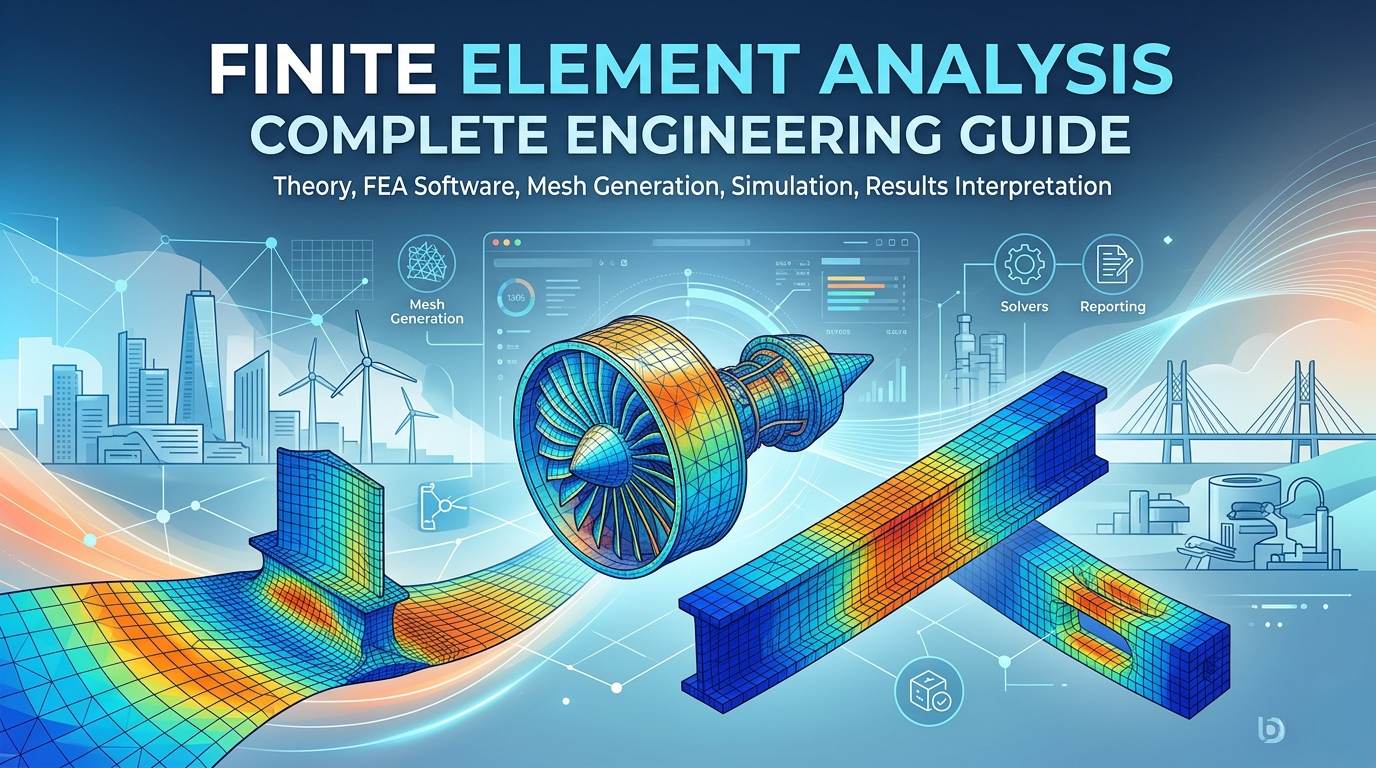
Imagine a complex engineering component, like an aircraft wing. Predicting the stress on the entire wing at once is incredibly difficult. FEA simplifies this by dividing the wing into a large number of small, simple shapes called “finite elements.” These elements are interconnected at points called “nodes,” forming a mesh that represents the entire structure. By applying mathematical equations to each element, the computer can approximate the behavior of the entire object with a high degree of accuracy.
Why is FEA Important in Modern Engineering?
FEA is crucial because it allows engineers to “see” the invisible. It reveals how a design will perform under pressure, identifies potential weak spots, and helps optimize performance long before manufacturing begins. This virtual testing process significantly reduces the need for expensive and time-consuming physical prototypes, accelerates the development cycle, and fosters more innovative and reliable designs.
Key Applications of Finite Element Analysis Across Industries
FEA is not limited to a single field; its applications are vast and varied. It is an essential tool in almost every sector of engineering and manufacturing.
How FEA is Used in Aerospace Engineering
In aerospace, safety and performance are paramount. FEA is used to analyze structural integrity, aerodynamics, and thermal effects on aircraft and spacecraft components. From wing stress analysis to turbine engine performance, FEA ensures that every part can withstand the extreme conditions of flight.
The Role of FEA in Automotive Design
The automotive industry relies heavily on FEA for everything from crash test simulations to engine performance optimization. It helps engineers design safer, more fuel-efficient, and more durable vehicles by analyzing factors like chassis stiffness, suspension dynamics, and occupant safety during a collision.
FEA Applications in Civil and Structural Engineering
For bridges, dams, and skyscrapers, FEA is vital for ensuring structural stability and safety. Engineers use it to simulate the effects of wind, earthquakes, and load distribution. This analysis helps create resilient structures that can stand the test of time, a core focus of many structural engineering services.
How Does Finite Element Analysis Work?
The FEA process is a systematic workflow that transforms a physical problem into a digital model and then into a set of actionable results. It generally consists of three main stages: preprocessing, solving, and postprocessing.
Step-by-Step Process of Finite Element Analysis
Each stage of the FEA process requires careful attention to detail to ensure the final results are accurate and meaningful.
Preprocessing: Setting Up the FEA Model
This is the most labor-intensive phase. It involves defining the geometry of the part, dividing it into a mesh of finite elements, assigning material properties (like steel or aluminum), and applying boundary conditions. Boundary conditions include defining loads (forces, pressures) and constraints (how the part is held in place).
Solving: Running Simulations and Analyzing Results
Once the model is set up, the FEA software takes over. Its powerful solvers apply complex mathematical equations to each element in the mesh. This phase is computationally intensive and can take anywhere from minutes to days, depending on the complexity of the model. The solver calculates variables like stress, strain, and temperature at each node.
Postprocessing: Interpreting FEA Data for Decision-Making
In the final stage, the raw numerical data from the solver is translated into visual formats. Engineers can view color-coded contour plots, animations, and graphs that make it easy to interpret the results. This visual feedback helps identify areas of high stress, excessive deformation, or other potential issues, guiding design improvements.
The Mathematics Behind Finite Element Analysis
FEA is built on a foundation of applied mathematics, primarily using matrix algebra and partial differential equations. The core idea is to approximate the governing equations of a physical system over each small element. By assembling the equations for all elements, the software creates a massive system of algebraic equations that can be solved simultaneously to find the behavior of the entire structure.
Common Software Tools for FEA
A wide range of software is available for performing Finite Element Analysis, from comprehensive commercial packages to open-source alternatives.
Comparing Popular FEA Software: ANSYS, Abaqus, and SolidWorks
- ANSYS: A widely used, powerful suite of tools offering extensive multiphysics capabilities.
- Abaqus: Known for its robust handling of complex nonlinear and dynamic analyses.
- SolidWorks Simulation: A popular choice for designers as it is integrated directly into the SolidWorks CAD environment, making it accessible and user-friendly for design validation.
Free vs. Paid FEA Software: Which One is Right for You?
Paid software like ANSYS or Abaqus offers comprehensive features, dedicated technical support, and trusted validation. Free or open-source tools can be excellent for learning, academic use, or simple problems but may lack the advanced capabilities and support required for complex commercial projects.
Benefits of Using Finite Element Analysis
Incorporating FEA into the engineering workflow provides numerous tangible benefits that impact a project’s timeline, budget, and final quality.
How FEA Improves Product Design and Development
FEA allows for rapid design iteration. Engineers can test dozens of design variations virtually to find the most optimal solution without the cost and delay of physical prototyping. This leads to better-performing, more innovative products. Our case studies demonstrate how simulation drives superior design outcomes.
Cost and Time Savings with FEA Simulations
By reducing the reliance on physical tests, FEA significantly cuts down on material and manufacturing costs. It also shortens the development cycle, allowing products to get to market faster. Identifying design flaws early in the digital phase prevents costly rework later in the production process.
Enhancing Safety and Reliability Through FEA
For critical applications, FEA is indispensable for verifying safety and reliability. By simulating worst-case scenarios, engineers can ensure a product will not fail under extreme conditions. This builds confidence in the design and protects end-users.
Challenges and Limitations of Finite Element Analysis
While incredibly powerful, FEA is not a magic wand. It is a tool that relies on the skill of the engineer and a clear understanding of its limitations.
Common Pitfalls in FEA and How to Avoid Them
The “garbage in, garbage out” principle applies strongly to FEA. Common mistakes include using an improper mesh, applying incorrect boundary conditions, or choosing the wrong material properties. Avoiding these pitfalls requires a solid theoretical understanding and practical experience.
Limitations of FEA in Complex Engineering Problems
FEA is an approximation of reality. Highly complex phenomena, such as turbulent fluid flow or fracture mechanics, can be challenging to model with perfect accuracy. The results are only as good as the assumptions made during the setup process.
How to Ensure Accurate Results in FEA Simulations
To ensure accuracy, it is essential to validate simulation results against real-world test data or theoretical calculations whenever possible. Performing a mesh convergence study—refining the mesh until the results no longer change significantly—is another critical step to verify result accuracy. For critical projects, consider partnering with an expert FEA consulting firm.
Finite Element Analysis in Canada
Canadian industries, from aerospace in Quebec to energy in Alberta, have embraced FEA as a tool for innovation and global competitiveness.
Top FEA Service Providers in Canada
Canada is home to numerous engineering firms that specialize in providing high-quality FEA services. These providers help businesses across the country solve complex engineering challenges and optimize their products. EngRx is a leading provider of these specialized services, leveraging advanced tools and expertise.
How Canadian Industries Leverage FEA for Innovation
Canadian companies use FEA to develop everything from more efficient oil and gas extraction equipment to advanced medical devices and sustainable building designs. This technology enables them to compete on a global scale by creating cutting-edge products.
Choosing the Right FEA Solution for Your Needs
Selecting the right software or service depends entirely on your specific project requirements, budget, and in-house expertise.
Factors to Consider When Selecting FEA Software
Consider the types of analysis you need (e.g., structural, thermal, fluid), your team’s skill level, your budget, and how the software integrates with your existing CAD tools.
How to Hire an FEA Consultant or Specialist
When hiring a consultant, look for deep industry experience, a strong portfolio of completed projects, and a clear understanding of your engineering challenges. An expert can provide insights that go beyond what software alone can offer. Feel free to contact us to discuss your project with one of our specialists.
In-House FEA vs. Outsourcing: Pros and Cons
Running FEA in-house gives you complete control but requires a significant investment in software and trained personnel. Outsourcing to a firm like EngRx gives you access to specialized expertise and advanced tools without the overhead, making it a cost-effective solution for many businesses.
The Future of Finite Element Analysis
FEA is continually evolving, with new technologies and methodologies pushing the boundaries of what is possible.
Emerging Trends in FEA Technology
Trends include the rise of generative design, where AI suggests optimal designs based on FEA results, and the development of digital twins, which are virtual replicas of physical assets that are updated with real-time data.
How AI and Machine Learning Are Transforming FEA
AI and machine learning are being used to speed up simulations, predict material properties, and automate the optimization process. This integration is making FEA faster, more intelligent, and more accessible.
The Role of Cloud Computing in FEA Simulations
Cloud computing provides on-demand access to massive computational power, allowing even small firms to run complex simulations without investing in expensive on-premise hardware. This democratizes access to high-performance computing and is a key enabler for the future of FEA.


Recent Comments